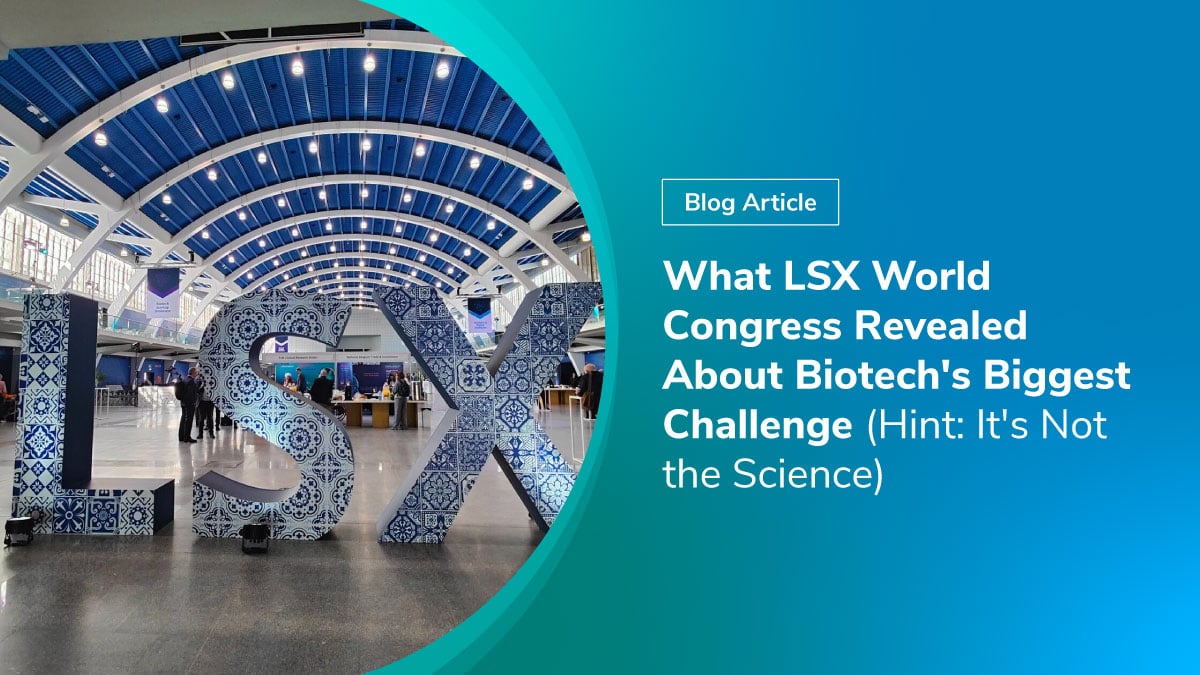
This week, Lisbon hosted two of Europe's most important life sciences events back to back: BIO-Europe Spring and LSX World Congress Europe. Over two packed days at LSX, I had the chance to listen to biotech founders pitch their science, sit in on investor panels, and connect with entrepreneurs, CRO leaders, and VCs from across the globe.
I came away energized - but also struck by a recurring theme that came up in almost every conversation I had.
The biotech industry doesn't have an innovation deficit. It has an execution deficit.
Paulo Rodrigues, Co-Founder & CTO/CPO, QMENTA
Biotech has a science problem? No. It has a time problem.
Why Biotech Timelines Are Still Painfully Slow in 2026
The quality of innovation on display was impressive. Biotech after biotech presented novel mechanisms, differentiated pipelines, and genuinely exciting therapeutic approaches. These are companies working on problems that matter - rare diseases, oncology, neurology - with science that could change patients' lives:
But then came the timelines.
First-in-human trials not expected until 2027/2028. For early-stage biotechs presenting, the next major milestone is still two or three years away.
Let that sink in. The science exists now. The patients need it now. But the path from lab to clinic is still agonizingly slow.
This isn't a criticism of any individual company - this is the reality of drug development, still in 2026. And it's a reality that should concern all of us.
What Biotech Investors Want in 2026: Why Phase 1 Is No Longer Enough
One of the most revealing sessions at LSX was "Inside the Investor Mind," featuring VCs from Forbion, Novo Holdings, Hadean Ventures, and Cancer Research Horizons, moderated by Chris Maggos of Cohesion Bureau.
The message was clear and consistent: the investment landscape has fundamentally shifted.
A few key takeaways from the panel:
Phase 1 is a milestone for the drug development. But not to investors. Investors today want to see a credible, funded path all the way to Phase 2 - with robust clinical data that demonstrates the drug is genuinely promising. That's the moment a pharma partnership or acquisition becomes realistic. And getting to Phase 2 with convincing data means having the right tools in place early - imaging biomarkers, patient stratification, objective measures of efficacy.
This is exactly where the operational infrastructure of a clinical trial becomes a strategic advantage, not just a logistics problem.
Rounds are bigger because the bar is higher. Investment sizes are increasing, but not from bullish optimism. It's about de-risking. VCs want to fund enough runway to reach a meaningful value inflection point, which now means Phase 2 data, not just a Phase 1 readout.
Due diligence is longer and more global. Timelines for closing a round have stretched to six months, sometimes a full year. Investors aren't just evaluating the science - they're mapping the global competitive landscape, including what's happening in Asia and specifically China.
China is an opportunity, not just competition. This was a nuanced and recurring point. Chinese biotechs can move faster and cheaper. Rather than viewing this purely as competitive pressure, several panelists suggested that European biotechs should explore strategic partnerships with Chinese organizations to accelerate their own development timelines.
Global Biotech Partnerships: Why Asian CROs Are Reshaping Drug Development
One of the most visible trends at LSX was the strong presence of Asian companies - biotechs and CROs alike, many from South Korea. They were actively looking to expand into European markets and establish partnerships.
This isn't just a footnote. It signals a fundamental shift in how drug development will work in the coming decade. The competitive and collaborative landscape is no longer regional. Biotechs that think globally - in their clinical strategy, their partnerships, and their operational infrastructure - will have a decisive advantage.
The panel on "Mapping investment and innovation in southern Europe" reinforced this from the European side.
Moderated by João Fonseca, Dean of the Medical School at the University of Lisbon, with speakers from Biovance Capital, Asabys Partners, Inveready, and 59 North Communications, the session highlighted how Southern Europe - Portugal, Spain, Italy, France - is rapidly emerging as a serious hub for biotech innovation, with growing talent pools, supportive public funding, and increasing private capital flows.
Lisbon itself was a fitting host. The city is vibrant, well-connected, and clearly making a statement about its place in the global life sciences ecosystem.
New Frontiers in CNS: Speed and Precision as the New Imperative
As a company deeply rooted in neuroimaging and brain health, the panel on "New Frontiers in CNS" was particularly close to home for me. Moderated by Wen-Yu Huang from Evaluate, with panelists from FundaMental Pharma, Aerska, Eli Lilly, and EQT Life Sciences, the session explored the cutting edge of neuroscience innovation - and reinforced every theme I've heard.
The excitement in CNS right now is real. Panelists highlighted promising advances across neurodegenerative diseases (Alzheimer's, Parkinson's, ALS), psychiatric disorders, epilepsy, and movement disorders. Jenny Laird from Eli Lilly noted that 2026 feels more stable for CNS, with exciting developments in psychiatry, dementia, and a growing emphasis on biomarkers feeding forward into better clinical decisions.
But the recurring message was unmistakable: "You need to be fast and capital efficient." Be fast and nimble - or get left behind.
Several themes stood out. Patient stratification is becoming critical - segmenting and stratifying populations using biomarkers, including promising work with fMRI, to identify the right patients for the right treatments. This is no longer optional; it's what separates trials that succeed from those that burn through capital without generating signal.
David Hardwicke from Aerska presented work on brain shuttles - payloads designed to cross the blood-brain barrier - highlighting how delivery innovation is opening entirely new therapeutic possibilities in CNS.
And Juliette Lee from EQT Life Sciences made a compelling case for digital biomarkers as tools for early detection and tracking disease progression, moving beyond traditional clinical scales that are slow, subjective, and often insensitive to meaningful change.
The brain is what defines us. Let's try to keep it healthy for the next decades.
Dirk Beher, FundaMental Pharma
And then the practical corollary - "Good quality science" combined with early tools, early signals, and a focus on prevention and early-stage intervention.
This is the future of CNS drug development: precision, speed, and the right tools to detect disease earlier and prove efficacy faster. It's also exactly where QMENTA sits - providing the imaging infrastructure and AI-powered biomarkers that help sponsors and CROs run smarter, faster CNS trials.
How to Accelerate Drug Development: What the Industry Still Gets Wrong
Here's the uncomfortable truth that kept surfacing at LSX: the bottleneck in biotech is not scientific innovation. And Europe is producing world-class science. The bottleneck is translation - how long, how slowly, and how expensively we move that science from the laboratory to the patient.
Clinical trials today still run on fragmented workflows, manual processes, and infrastructure that hasn't fundamentally changed in decades. When a biotech's next inflection point is three years away, that's not just a business problem - it's a patient problem.
This is exactly the challenge we're building QMENTA to solve.
Our mission has always been to accelerate the journey from lab to patient. We do this by reimagining how imaging-driven clinical trials operate - replacing fragmented, manual workflows with a unified, AI-powered platform that compresses timelines and reduces the operational burden on sites, sponsors, and CROs.
When investors are asking biotechs "what's your plan to get to Phase 2?", the answer increasingly depends on operational infrastructure - the tools, platforms, and partners that can help trials run faster and smarter. That's where we come in.
QMENTA's Role in Closing the Biotech Execution Gap
LSX World Congress Europe was my first time attending, and it exceeded expectations. The format was efficient, the content was sharp, and the networking was genuinely valuable. A big thank you to the LSX team - Ryan and the entire crew - for organizing such a high-quality event.
It was also a pleasure connecting with fellow entrepreneurs and industry leaders throughout the week. These conversations fuel the work and remind you why it matters.
If there's one takeaway I'd leave you with, it's this: the biotech industry doesn't have an innovation deficit. It has an execution deficit.
And closing that gap between the science that exists today and the patients who need it is the defining challenge of our industry.
At QMENTA, we're determined to be part of the solution. I’m always happy to talk with others who care about accelerating innovation in biotech. Let’s connect I’d love to hear your perspective.
Frequently Asked Questions
What is the biggest challenge in biotech drug development today?
The primary bottleneck in biotech drug development is not scientific innovation but operational execution — the speed, cost, and efficiency with which promising science moves from the laboratory into clinical trials and ultimately to patients. Despite remarkable advances in molecular biology and therapeutic science, the average timeline from discovery to first-in-human trials remains measured in years. Industry observers at events like LSX World Congress Europe consistently identify this execution gap as the defining challenge of the current era in biopharma.
Why is Phase 1 no longer enough for biotech investors?
The venture capital community has fundamentally shifted its expectations for biotech investment. Phase 1 completion, which demonstrates only initial safety, is no longer considered a meaningful value inflection point for most therapeutic programmes. Investors now expect founders to present a credible, funded path to Phase 2 with robust clinical data demonstrating genuine efficacy signals. This shift reflects the longer and more intensive due diligence processes now standard at leading life sciences funds, where evaluation timelines commonly extend to six months or more.
How can imaging biomarkers accelerate CNS clinical trials?
AI-powered imaging biomarkers enable more objective, reproducible, and rapid evaluation of drug efficacy in CNS trials compared to traditional clinical rating scales. By providing quantitative measures of brain structure and function — such as lesion volume in multiple sclerosis or regional atrophy in Alzheimer's disease — imaging biomarkers allow trial teams to detect meaningful treatment signals earlier and with greater precision. This improves patient stratification, reduces sample size requirements, and compresses the time to Phase 2 data readouts.
What role does clinical imaging infrastructure play in reaching Phase 2 faster?
The operational infrastructure of a clinical trial — including imaging data collection, quality control, biomarker analysis, and central review — is not merely a logistics problem; it is a strategic determinant of trial speed. Fragmented imaging workflows, manual data handling, and siloed analysis tools introduce delays at every stage. Unified, AI-powered imaging platforms replace this fragmentation with automated, end-to-end workflows that reduce site burden and accelerate the production of high-quality imaging data for regulatory review.
Why are Asian CROs increasingly relevant to European and US biotech companies?
Asian contract research organisations, particularly those based in South Korea and China, are able to conduct clinical trials faster and at lower cost than their Western counterparts in many therapeutic areas. Rather than viewing this purely as competitive pressure, European and US biotech companies are increasingly exploring strategic partnerships with Asian CROs to accelerate their own development timelines — accessing larger patient populations and lower operational costs without sacrificing data quality. This trend was prominently discussed at LSX World Congress Europe 2026.
What does "capital efficiency" mean in the context of CNS drug development?
Capital efficiency in CNS drug development refers to maximising the scientific value generated per dollar invested in a trial programme. In practice, this means using tools and platforms that reduce operational overhead — such as automated imaging workflows, AI-powered patient stratification, and digital biomarkers — so that a larger proportion of the trial budget reaches scientific objectives rather than administrative costs. CNS trials are particularly expensive and high-risk, making capital efficiency a critical factor in whether a programme can reach meaningful clinical milestones.
Accelerate CNS trials with imaging infrastructure built for execution
QMENTA helps sponsors and CROs run faster, smarter imaging-driven clinical trials with AI-powered biomarkers, centralized workflows, and infrastructure designed to reduce operational burden.
Let’s connect
About the author: Paulo Rodrigues, Co-Founder & CTO/CPO, QMENTA
Paulo is Co-Founder and CTO/CPO at QMENTA, a neuroimaging AI company accelerating clinical trials for brain diseases. Learn more at qmenta.com.