AI Imaging Biomarkers Marketplace
AI imaging biomarkers, governed at every timepoint.
Run 50+ validated imaging AI workflows and biomarker tools, bring your own models, or integrate third-party algorithms, all in one governed cloud environment. Every run is version-locked, audit-trailed, and reproducible, so the model applied at baseline is the same model applied at every later timepoint.
50+
Validated imaging AI workflows and biomarker tools
250+
Imaging sites in production
16M+
Imaging files processed across all programs
1.3M
Subjects across trials, academic centers, and biopharma programs
Imaging AI that cannot enter a regulated environment does not count.
Most imaging AI lives in scripts, local installs, and one-off pipelines that only one person understands. Getting a model into a regulated study can take months of integration work. Scanner variability reaches the model unharmonized, results cannot be reproduced at the next timepoint, and there is no chain of custody when a reviewer asks how a number was produced.
Under the FDA's Real-Time Clinical Trials initiative, these are no longer back-end inconveniences. A biomarker result that cannot be reproduced or traced becomes a finding the moment it is questioned.
Where imaging AI stalls
AI models that take months of integration work before they can run in a regulated environment.
Harmonization breakdowns across scanner manufacturers that no one catches until the analysis phase.
Pipeline versions that change between baseline and follow-up, so longitudinal change can reflect the software rather than the patient.
Black-box outputs with no version history and no audit trail, and no answer when a regulator asks how a measurement was produced.
What changes with QMENTA
The marketplace runs inside the governed layer, not beside it. Harmonization happens before the model runs, every run is version-locked and captured in the audit trail, and the output is analysis-ready and audit-ready at the same time. Where your current workflow discovers problems late, this one surfaces them immediately.
50+ validated workflows. Gold standards and proprietary tools in one place.
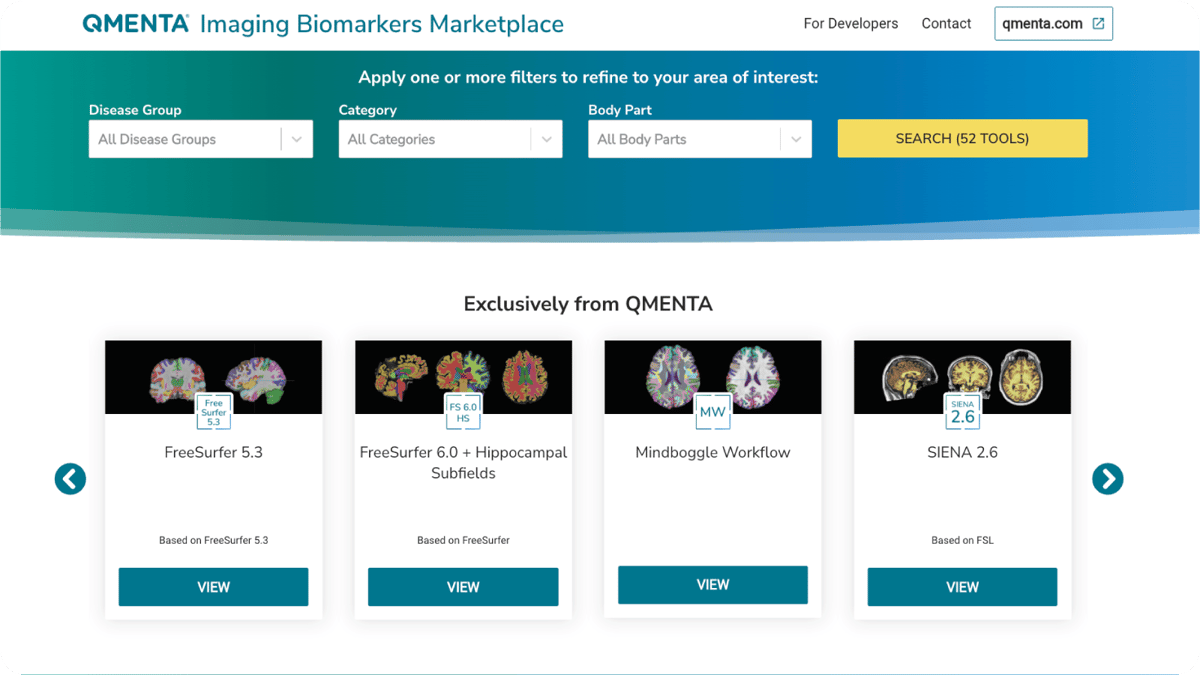
The marketplace brings together widely used open-source algorithms, including FreeSurfer, FSL, and SIENAX, alongside QMENTA's proprietary biomarkers and AI tools from partner companies. Tools cover neurology, oncology, and cardiology, among other areas. Each tool carries its source references and version history. Search by disease group, category, or body part, then run it in a few clicks. No coding required.
Open-source gold standards
Reference algorithms reviewers already know.
FreeSurfer, FSL, SIENAX, and other widely used reference tools, packaged and version-pinned so results reproduce across sites and across time, with no installation or compute to manage.
QMENTA proprietary
Biomarkers built by neuroimaging scientists.
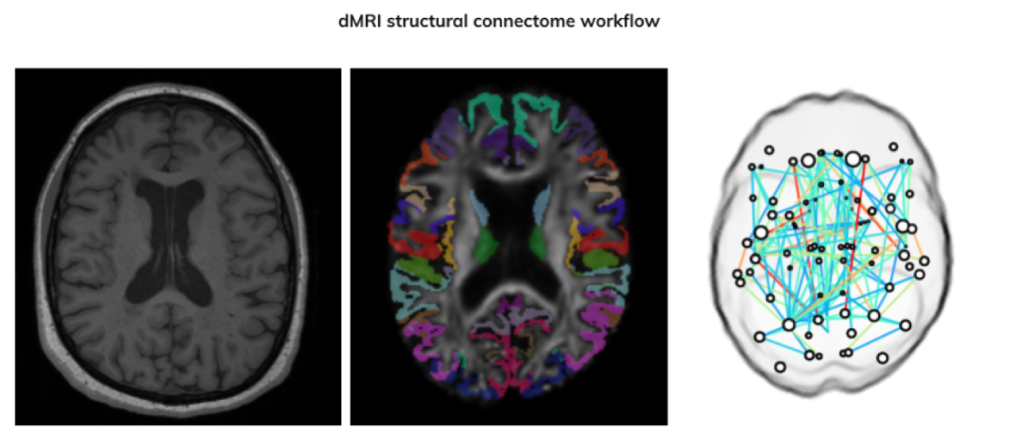
Volumetric, lesion, and diffusion measures developed by QMENTA's own team, including lesion load, Diffusion Tensor Imaging, and FiberMapper's automated segmentation of 16 fiber tracts.
Partner AI
Third-party biomarkers, under the same governance.
AI imaging biomarkers from partner companies, integrated through the QMENTA SDK and run with the same version lock, audit trail, and harmonization as everything else in the marketplace.
Browse by category
One marketplace, built into every QMENTA product.
The same library and the same governance underneath Trials, Foundation, and Legal. What changes is the rigor each product applies around it.
QMENTA Trials
Governed imaging endpoints for industry-regulated neuro trials.
Atrophy, lesion, and diffusion measures run under GxP and 21 CFR Part 11 controls, version-locked from baseline to database lock, with the audit trail carried into the submission package. Sponsors, CROs, and core labs read the same results in one system.
QMENTA Foundation
Develop, train, validate, and deploy your own imaging AI, any therapeutic area.
The full marketplace is available from day one in Discovery. Bring your own model, train and validate it on your curated, harmonized data, and carry the same version-locked deployment into a Study or into a Pivotal validation study supporting a 510(k), De Novo, or PMA submission.
QMENTA Legal
FiberMapper: automated DTI quantification for TBI cases.
QMENTA's own white-matter tool lives in the marketplace and powers QMENTA Legal. Imaging centers and law firms get a standardized, quantified report of white-matter damage that standard radiology reads can miss, pay-per-scan, with no commitment and no in-house DTI specialist required. QMENTA Legal operates under data privacy and patient consent controls. It does not carry GxP or 510(k) status.
What the marketplace actually does.
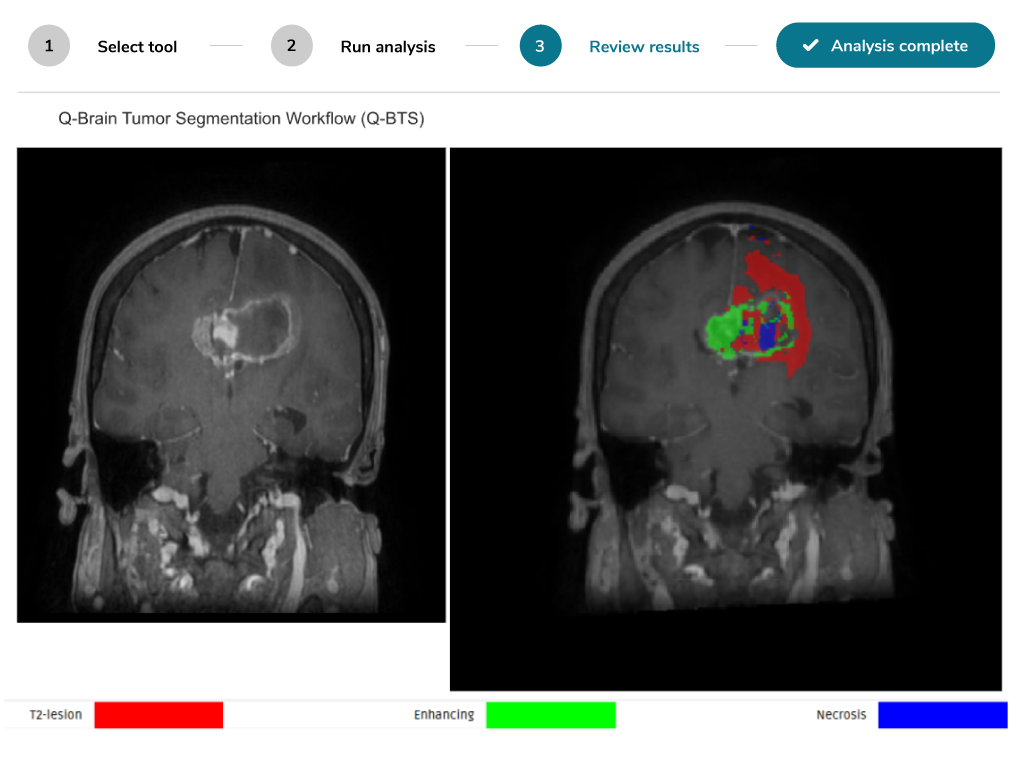
Select a biomarker, run it, review the result. A few clicks.
Pick a tool from the marketplace, point it at a subject or a cohort, and run. Results land in the platform's zero-footprint browser viewer with the source images and outputs side by side, under role-based access and automated audit logging. Run several biomarkers on the same data simultaneously, or process large volumes in a single pass.
+No coding, no local install, no compute to manage
+Run multiple tools in parallel on the same subjects or cohorts
+Results reviewed in the browser viewer alongside source images
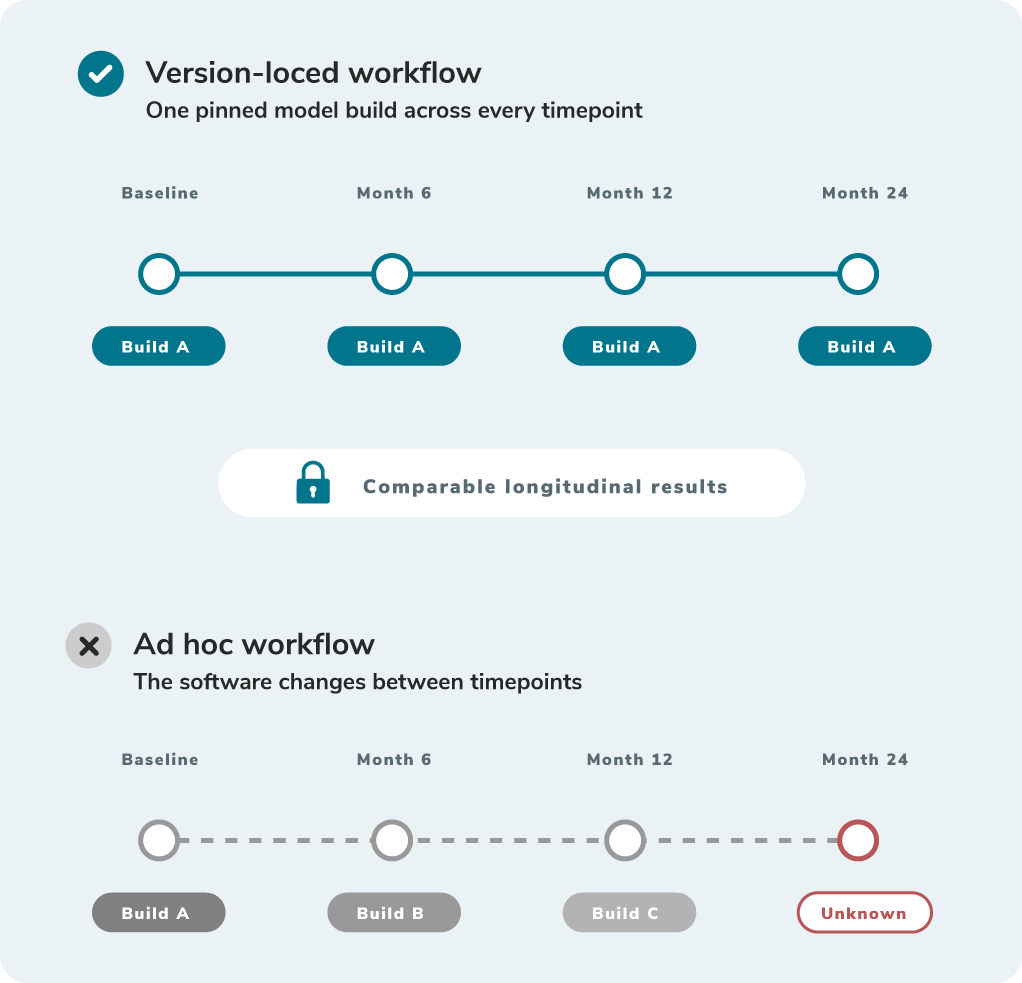
The model applied at baseline is the model applied at every later timepoint.
Every tool in the marketplace runs in a governed cloud environment. Each model is version-locked, audit-trailed, and reproducible, so longitudinal change is never the result of a software update. No black box, and no open question when a monitor or a regulator asks which version produced a number.
+Version-locked deployment for QMENTA, open-source, partner, and your own models
+Every run captured in the audit trail with the model version that produced it
+Reproducible on demand for a monitor, an auditor, or a regulator
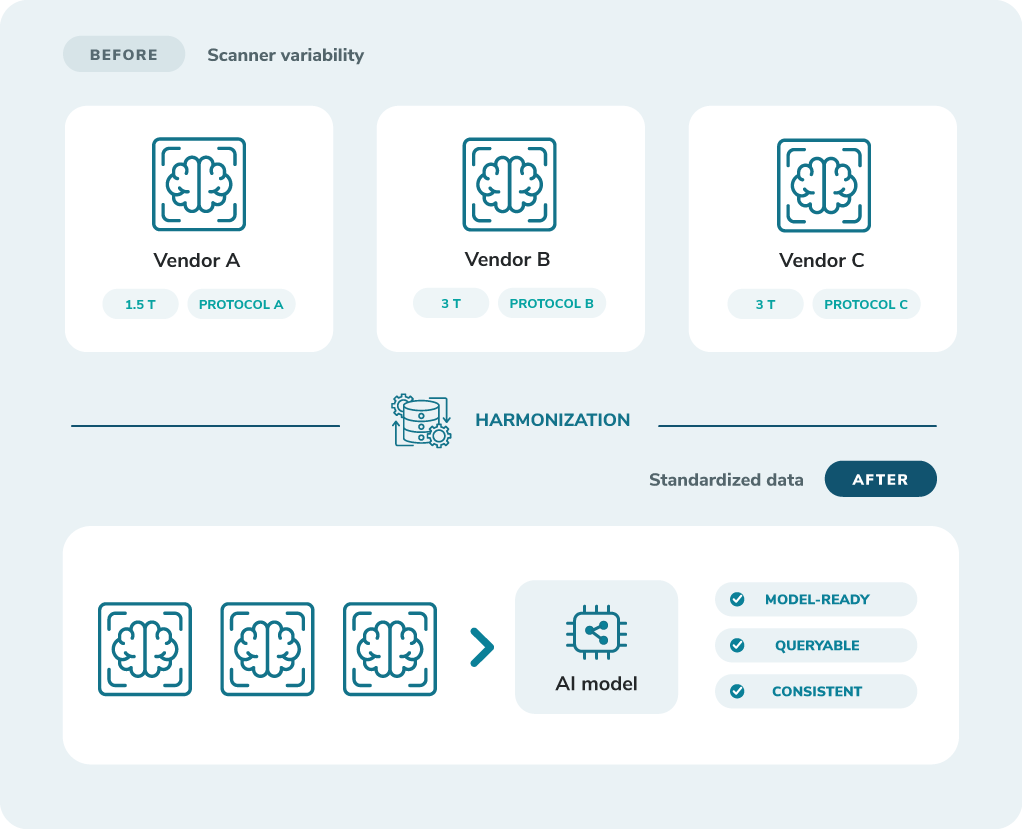
Scanner variability standardized before it reaches the model.
Data acquired across GE HealthCare, Siemens Healthineers, Philips, Canon, United Imaging, and any DICOM system is standardized across manufacturers, field strengths, and protocols before a biomarker runs on it. The variation that silently degrades AI output is handled at the infrastructure level, with original files always preserved.
+Vendor-neutral across all major manufacturers and any DICOM system
+Field-strength and protocol differences standardized automatically before analysis
+Harmonized data queryable; source files never overwritten
Connect, train, and validate your own algorithms.
A semi-automatic workflow combines automated calculations with manual review, so you can check a biomarker's output against expert reads while you train it. The platform curates and harmonizes your multi-site data and gives you a governed place to run the model. It supports your validation study; it does not replace study design, reader studies, ground truth, or endpoints.
+Automated calculations paired with manual review steps
+Validate on your multi-site, multi-vendor data so results reflect real-world variability
+A path from development to a regulated validation study without a migration
Integrate existing algorithms without rebuilding them.
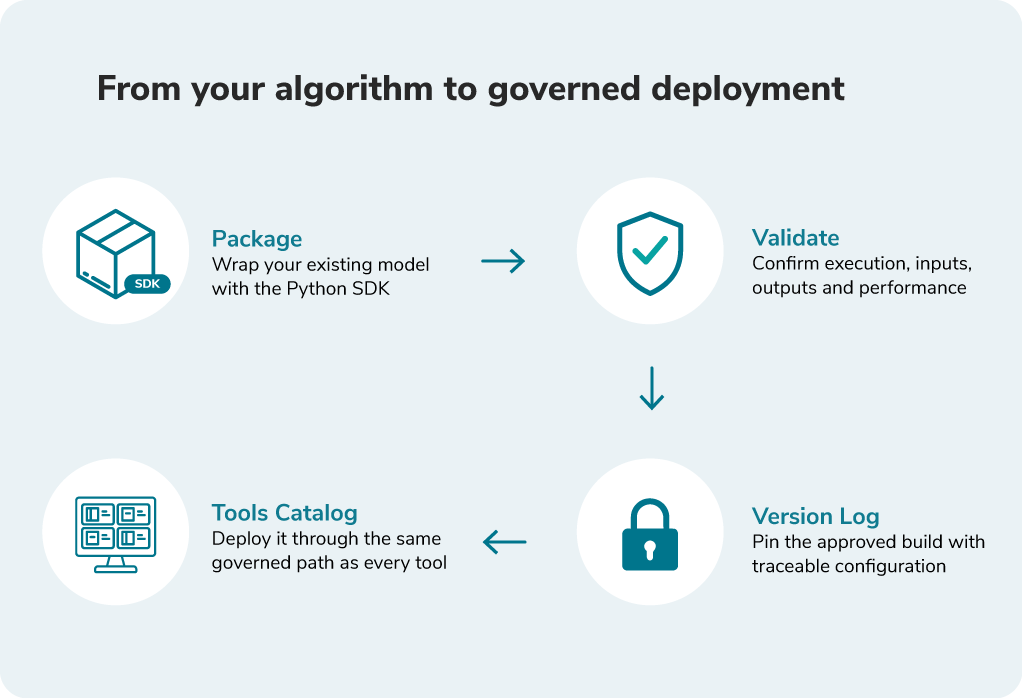
Bring your own or any existing AI imaging biomarker, image-processing tool, or ML model onto the platform through the QMENTA SDK, with documentation and support from a team that has been building this technology for more than ten years. Once integrated, your tool runs under the same version lock, audit trail, and harmonization as everything else in the marketplace.
+Python SDK, documentation, and support included
+Your model and your IP, running under QMENTA governance
+Same deployment path for proprietary, partner, and open-source tools
A biomarker validated in a study run on QMENTA changed how MS is diagnosed.
CAVS-MS, an NIH-funded multi-site study run through Cleveland Clinic and involving Cedars-Sinai and other institutions, validated the Central Vein Sign as a diagnostic imaging biomarker for Multiple Sclerosis and contributed to revising the McDonald Criteria, the global diagnostic standard. Imaging data from more than 400 patients across leading North American academic MS centers ran through a single standardized pipeline on QMENTA.
From research to clinical practice in about five years, against an industry norm of a decade or more. No scientific shortcuts. The infrastructure simply kept pace with the science.
CAVS-MS, Cleveland Clinic
NIH-funded multi-site study, run on QMENTA Foundation, Study use case
400+
Patients across North American academic MS centers
Compliance is a mechanism, not an adjective.
Every tool in the marketplace inherits the platform's controls: chain of custody from first scan to submission, automated time-stamped logs, and data capture at the infrastructure level. That is what makes a biomarker result hold up when a monitor, an auditor, or a regulator asks how it was produced.
The 510(k) clearance (K202718) covers the QMENTA platform as a medical image management and processing system. It is not a clearance of individual AI workflows or biomarkers as diagnostic devices. GxP and 21 CFR Part 11 controls do not extend to QMENTA Legal.
GCP, AWS, or Azure
Deployable on whichever cloud meets your security and procurement requirements.
Vendor-neutral DICOM
GE HealthCare, Siemens Healthineers, Philips, Canon, United Imaging, and any DICOM-compliant system.
Zero nonconformities
Across all external pharmaceutical partner audits to date. Your procurement team will ask; the answer is clean.
Fully independent
No pharmaceutical company investment in the platform, a governance requirement in regulated CNS and oncology trials.