The Imaging Hub: the platform under every QMENTA product
The AI orchestration fabric for regulated medical imaging.
One governed layer that connects your scanners, sites, models, and regulators into a single auditable system. The Imaging Hub is the infrastructure underneath QMENTA Trials, Foundation, and Legal: ingestion, real-time QC, AI orchestration, central review, and compliance, in one place.
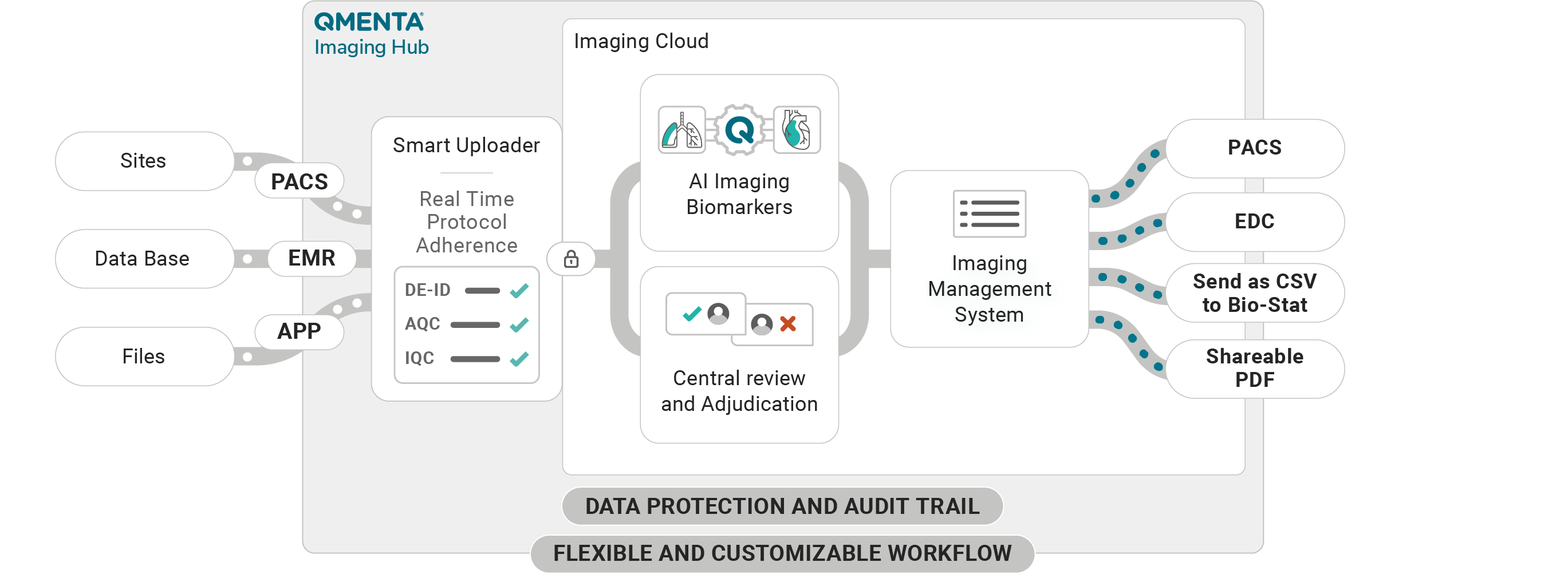
The 510(k)-cleared platform and full GxP and 21 CFR Part 11 stack support regulated neuro trials on Trials. Foundation applies the compliance level each use case requires, up to submission-ready validation for AI medical devices. Legal operates under a different regulatory profile.
250+
Imaging sites in production
16M+
Imaging files processed
1.3M
Subjects across trials, academic centers, and biopharma programs
50+
Validated imaging AI workflows and biomarker tools
From retrospective discovery to real-time prevention.
Developing diagnostics or therapeutics takes large volumes of imaging data that arrive variable and unstandardized, through tools that were not built for the scale, speed, or regulatory scrutiny of modern imaging-intensive studies. The failures that follow are predictable, and each one costs time, budget, and submission risk.
The shift
Problems discovered late
→ Surfaced immediately
Manual intervention
→ Automated workflows
Audit exposure
→ Audit readiness
Protocol deviations
Typical workflow
Discovered weeks after the rescan window has closed. Data lost, timelines extended.
With the Imaging Hub
Flagged at upload by automated protocol adherence checks, while the rescan window is still open.
QC failures
Typical workflow
Found at central review, when it is too late to recover the scan.
With the Imaging Hub
Automated image and protocol QC runs at upload, with a clear remediation path back to the site.
Scanner variability
Typical workflow
Harmonization breakdowns across manufacturers and sites that nobody catches until the analysis phase.
With the Imaging Hub
Automated protocol checks at upload, flagging scanner and protocol mismatches early, with original files preserved.
AI deployment
Typical workflow
Custom integration work before a model can run in a governed environment, repeated for every new algorithm.
With the Imaging Hub
A governed environment where your own, QMENTA's, or third-party models run version-locked, audit-trailed, and reproducible. Validation evidence is still yours to generate; the Hub is where it is generated and recorded.
Database reconciliation
Typical workflow
Manual reconciliation at closeout that can take months and introduce errors.
With the Imaging Hub
Reconciliation runs against the audit trail the study has been building since day one. The submission package builds continuously, not under pressure at the end.
Audit requests
Typical workflow
Inbox archaeology across disconnected systems and email chains.
With the Imaging Hub
The full chain of custody lives in one system. When a regulator asks a question, the answer is already logged.
Real-time trials change when you find out, not what can go wrong.
Under legacy trial models, imaging problems were back-end discoveries: found at central review, managed at closeout, occasionally surfacing as audit findings. The financial consequence was real but deferred.
Under the FDA's Real-Time Clinical Trials initiative, protocol deviations, QC failures, and harmonization breakdowns become financially material the moment they occur. Teams and systems built for retrospective discovery will not be sufficient.
The Imaging Hub was built for the conditions RTCT creates: continuous ingestion, real-time QC alerts, automated protocol adherence, longitudinal monitoring, and a full audit trail from day one.
Six components. One auditable system.
Each component has its own page. Together they are one system with one audit trail, so a study never has to move data between tools.
Ingest
Smart Uploader
Cloud-based upload from any site and any scanner: drag-and-drop for coordinators, direct PACS connector or bulk transfer for sites. Real-time protocol adherence, automated PHI removal, and image and data quality checks run at upload, so deviations surface while the rescan window is still open. Drag-and-drop sites need no IT project or VPN, and most are uploading on day one.
Learn moreStore
Imaging Cloud
A secure, auditable, scalable environment that works with all medical imaging formats and is vendor-neutral across GE HealthCare, Siemens Healthineers, Philips, Canon, United Imaging, and any DICOM system. Original files are always preserved.
Learn moreAnalyze
AI Imaging Biomarkers
A library of 50+ validated imaging AI workflows and biomarker tools, ready to run standalone or combined, plus a governed environment to deploy your own or third-party algorithms through the API. Every model is version-locked, audit-trailed, and reproducible: the model applied at baseline is the model applied at every later timepoint.
Learn moreReview
Central Review
Sites, CROs, sponsors, and radiologists work on the same data in real time through a zero-footprint browser viewer with fast load times and no local installation. Dedicated worklists, structured double-read and adjudication workflows, and role-based access replace fragmented file transfers and local reading on office computers.
Learn moreManage
Management System
Imaging EDC, query management, and reporting in the same system as the images, so operational status, endpoint data, and audit history stay linked instead of reconciled later. Configurable to your protocol's workflow, from a single read to multi-reader adjudication, without custom development.
Protect
Security and Compliance
Full control and visibility at every step of the study. Automated time-stamped audit logging from day one and a full chain of custody from first scan to regulatory submission. For regulated neuro trials on Trials, that runs on a platform with FDA 21 CFR Part 11, HIPAA, GDPR, ISO 13485, and GxP compliance built in. Foundation applies the level each use case requires.
Learn moreOne platform. Three products.
The same infrastructure, configured to the regulatory level each kind of work requires. Pick the product that matches your program; the platform underneath is the same.
For industry-sponsored neuro trials
Trials
Governed neuroimaging for industry-regulated clinical studies.
+Real-time QC, AI, and central review in one system
+GxP and 21 CFR Part 11 compliant, built to support FDA and EMA submissions
+Sponsors, CROs, and core labs on one platform
For imaging AI and research programs
Foundation
Collect, organize, develop, and deploy imaging AI across any disease area.
+From model development to regulated validation, each at its own compliance level
+Neuro, cardiac, oncology, and beyond
+AI companies, academic centers, hospitals, and research consortia
For TBI litigation
Legal
Automated DTI quantification for TBI litigation.
+Automated segmentation of 16 white matter fiber tracts
+Used by independent imaging centers, with reports built for personal injury and TBI litigation
+Pay per scan. No subscription.
Every week removed from a timeline has a dollar value. The Hub can remove weeks across site activation, QC, harmonization, review, and closeout.
Each stage compresses when the infrastructure stops being the bottleneck. That is not a scientific achievement. It is what happens when imaging operations no longer slow down the science.
The proof point is CAVS-MS, an NIH-funded multi-site study run through Cleveland Clinic, with QMENTA as the operational backbone.
Translation timeline
About 5 years
From research to clinical practice, against an industry norm of a decade or more
Validated biomarker
Central Vein Sign
Imaging biomarkers validated across the multi-site study
Clinical impact
McDonald Criteria
The global diagnostic standard for MS, revised with contributions from the study
See the evidence
Read the Cleveland Clinic case study →Audit readiness is an architecture decision.
The Hub was designed for regulated medical imaging from day one, not retrofitted when an audit arrived. Chain of custody, time-stamped logging, and data capture at the infrastructure level are what make an audit trail hold up, and they are in place from the first scan.
The GxP and 21 CFR Part 11 stack supports regulated neuro trials on Trials. Foundation and Legal solutions applies the compliance level each use case requires, up to submission-ready validation for AI medical devices. Legal operates under a different regulatory profile, described on the Legal product page.
Audit record
Zero nonconformities
Across all external pharmaceutical partner audits to date. Your compliance team will ask. The answer is clean.
Governance
Fully independent
No pharmaceutical company investment in the platform. In regulated CNS and oncology trials, independence is a contractual and governance requirement, not a differentiator.
Interoperability
Vendor-neutral
GE HealthCare, Siemens Healthineers, Philips, Canon, United Imaging, and any DICOM-compliant system.
Trusted by


Talk to our team.
Tell us about your program. We will show you which product fits, how quickly your sites can start uploading, and what changes when imaging stops slowing your science.
Running a clinical trial? Explore Trials | Building imaging AI? Explore Foundation | Quantifying a TBI case? Explore Legal