Foundation · AI Data Platform

A governed data layer for medical imaging AI.

Collect, organize, label, harmonize, and validate medical imaging data across any therapeutic area and any modality. Foundation gives AI companies, academic centers, hospitals, and research consortia governed infrastructure that grows with the work, from first dataset to regulatory submission.

FDA 21 CFR Part 11 HIPAA GDPR ISO 13485

16M+

Imaging files managed and processed across all programs

250+

Imaging sites in active production

50+

Validated AI workflows available on day one

1.3M

Subjects across trials, academic centers, and biopharma programs

The problem

Your data program is held together with manual workarounds.

Building imaging AI needs large, well-organized, consistent datasets. Most teams assemble this from PACS exports, shared drives, and one-off scripts that only one person understands. The result is inconsistent data quality, slow iteration, and no clear path to a regulated validation study when the model is ready for market.

Foundation replaces that patchwork with governed infrastructure: one system for collection, organization, annotation, harmonization, AI deployment, and compliance, set to the level of rigor your stage of work actually requires.

Where data programs break down

!

Imaging data is generated in high volumes but sits across institutions with no infrastructure to make it usable at scale.

!

Inconsistent formats and scanner variability across sites degrade model training and cross-site analysis.

!

Custom, one-off pipelines leave no chain of custody when a regulated validation study is needed.

!

Multi-site coordination and harmonization break down when no single system governs the data.

Who it serves

One platform, four kinds of teams.

AI and medical device companies

Building imaging software in any therapeutic area. Discovery for model development and data curation. Pivotal for the multi-site validation study that supports a 510(k), De Novo, or PMA submission.

Neuro, oncology, cardiology, GI, retinal, pulmonary, and beyond.

Academic medical centers and core facilities

Running imaging research programs, operating core imaging facilities, or participating in multi-site studies. The Discovery and Study use cases give the coordination infrastructure that institutional IT and shared drives cannot.

Cleveland Clinic, UCSF, Harvard Medical School.

Government-funded research consortia

NIH R01 and R21 programs, EU Horizon, UKRI, and comparable multi-institution studies with IRB approval. The Study use case gives the rigor of multi-site data integrity without the full GxP burden of a drug-approval trial.

NIH, EU Horizon, UKRI, multi-institution imaging consortia across all areas.

Hospital networks and pharma R&D

Hospitals building imaging data infrastructure for research or AI partnerships, and pharma R&D teams running model-development programs outside an active industry-sponsored trial. Discovery or Study depending on scope.

Integrated health systems, pharma data science teams, healthcare AI partnerships.

Three use cases, one platform

Same platform, three different jobs.

Each use case matches a different kind of work. Compliance and rigor increase across them; the platform stays the same, so expanding from one to another is a change of configuration, not a migration.

Model development

Discovery

For AI teams and researchers building and curating imaging datasets for model development.

+Collect and organize imaging data from any source, any modality

+Annotation and labeling tools for model-training datasets

+Automated harmonization across scanner vendors

+50+ validated AI workflows available immediately

+PACS connector, bulk upload, or drag-and-drop

Priced by:

Platform access and data volume. Regulatory burden: low.

Talk to us

Multi-site research

Study

For IRB-approved multi-site research studies run with government or consortium funding.

+Everything in Discovery

+Multi-site coordination across participating institutions

+IRB-compatible data management and consent tracking

+Protocol adherence monitoring across sites

+Harmonization across manufacturers, field strengths, and protocols

+Shared review: sites and investigators on the same data

Priced by:

Access, data volume, and multi-site scope. Regulatory burden: low to medium.

Talk to us

Device validation

Pivotal

For SaMD companies running regulated multi-site validation studies for FDA device submission.

+Everything in Study

+FDA 21 CFR Part 11 and ISO 13485 controls for submission-ready device validation

+Full audit trail from first scan to submission package

+Version-locked AI model deployment with full reproducibility

+Submission-ready evidence package built continuously, not assembled at the end

Priced by:

Adds compliance and audit-readiness premium. Regulatory burden: medium.

Talk to us
Platform capabilities

What Foundation actually does.

Data ingestion

Any scanner, any site, any format. Productive from day one.

Sites upload via direct PACS connector, bulk transfer, or drag-and-drop. No IT projects, no VPN setup, no specialist required. Automated PHI removal happens at ingestion. Multi-site data lands in one place without the coordination overhead that delays most programs by weeks.

+Ingests DICOM, NIfTI, and other standard imaging formats in one place

+Vendor-neutral: GE HealthCare, Siemens Healthineers, Philips, Canon, United Imaging, and any DICOM or research imaging format

+Automated PHI removal built into the upload workflow

+Deployable on GCP, AWS, or Azure to meet your requirements
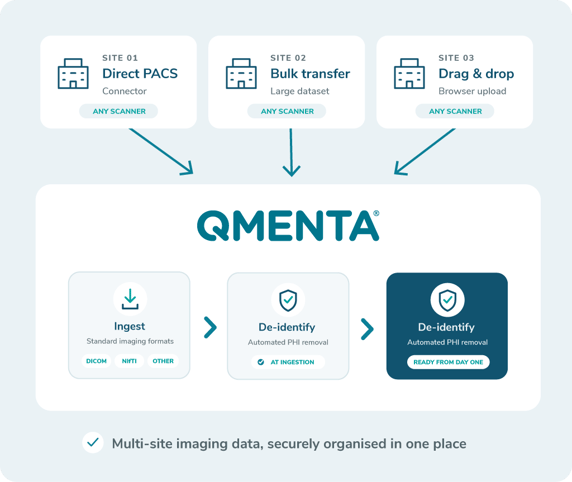
Multi-site upload flow diagram<
Harmonization

Scanner variability resolved before it reaches your model.

Data acquired across multiple manufacturers, field strengths, and protocols is standardized before it reaches a scientist or a model. The multi-vendor, multi-field-strength variation that silently degrades AI performance is addressed at the infrastructure level, with original files always preserved.

+Cross-vendor standardization across all major systems

+Field-strength and protocol harmonization applied automatically

+Harmonized data queryable; source files never overwritten
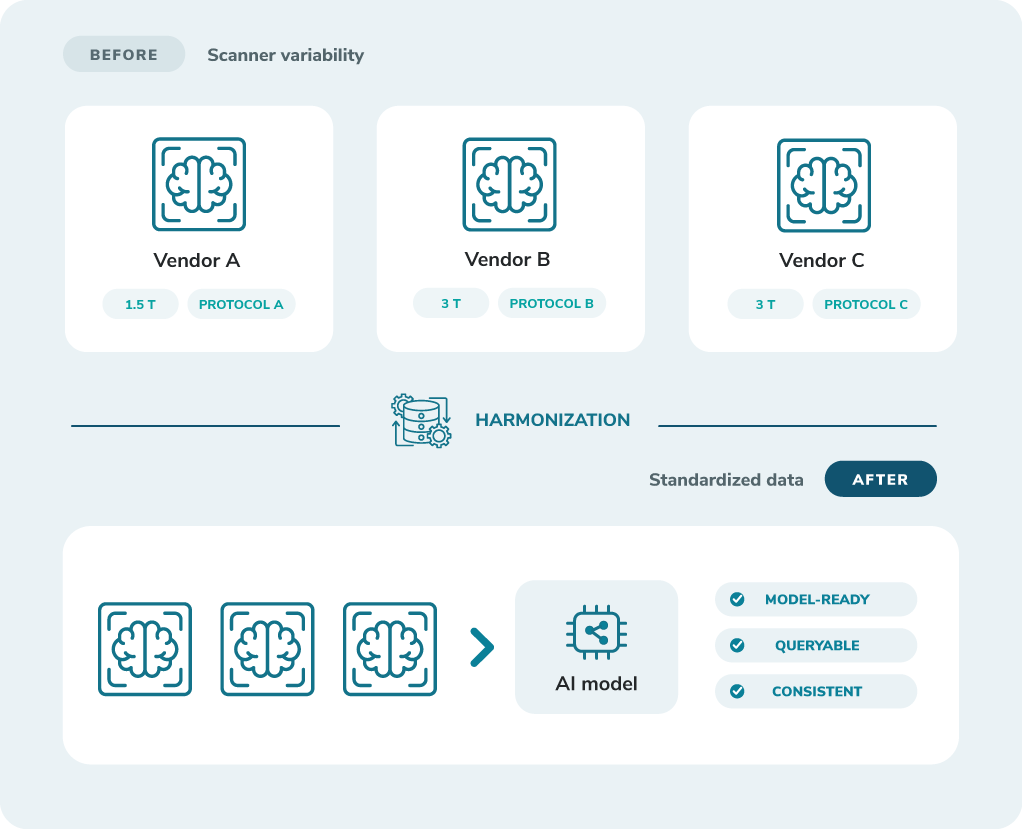
Before/after harmonization diagram
Annotation and curation

Labeled, curated training data without a custom toolchain.

Foundation provides the labeling and curation infrastructure AI teams usually build from scratch: structured tools to collect, organize, label, and share imaging datasets in one governed system, instead of stitching separate tools together.

+Structured labeling workflows for any therapeutic area or modality

+Collect and organize datasets in one governed system

+Share datasets across teams and collaborating institutions
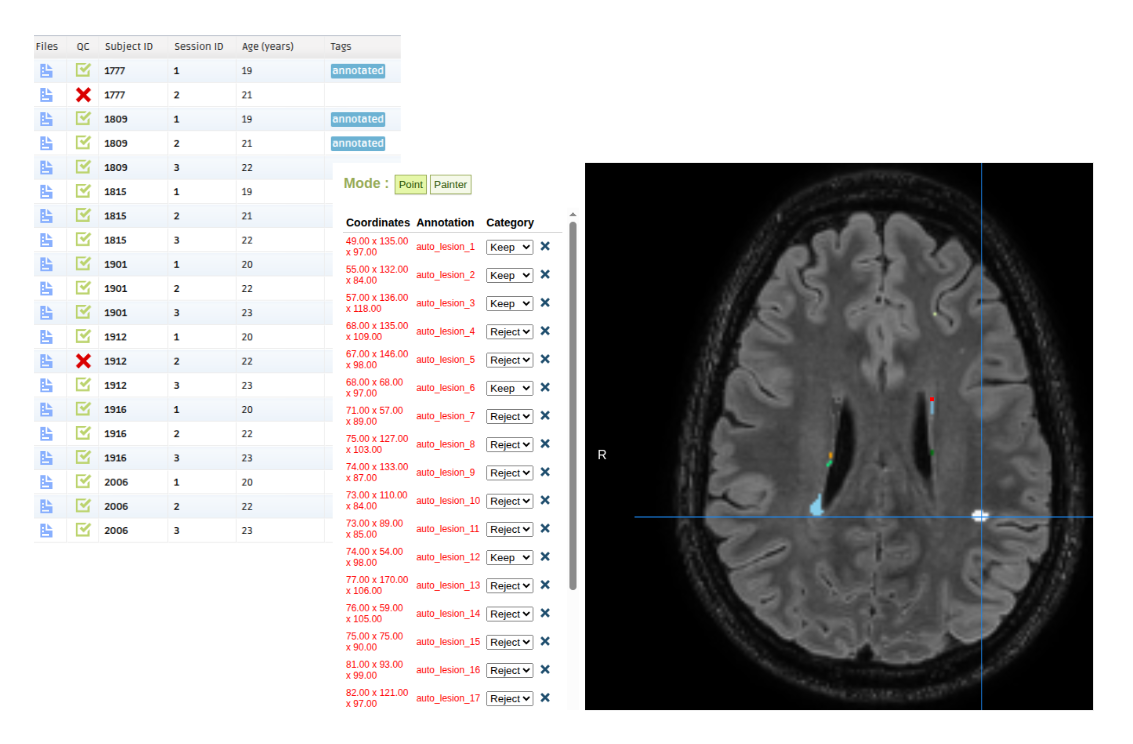
 

Dataset organizer and labeling tools image
AI deployment

Run and manage AI algorithms in a governed environment.

Deploy, run, and scale AI algorithms in a governed cloud environment. Use QMENTA's 50+ validated imaging workflows, bring your own models, or integrate third-party algorithms. Every run is version-locked and reproducible, so the model applied at baseline is the same model applied at every later timepoint. Infrastructure supports your validation study; it does not replace study design, reader studies, or endpoints.

+50+ validated imaging workflows available immediately

+Bring your own models or deploy third-party algorithms alongside QMENTA's

+Version-locked, audit-trailed, reproducible model runs
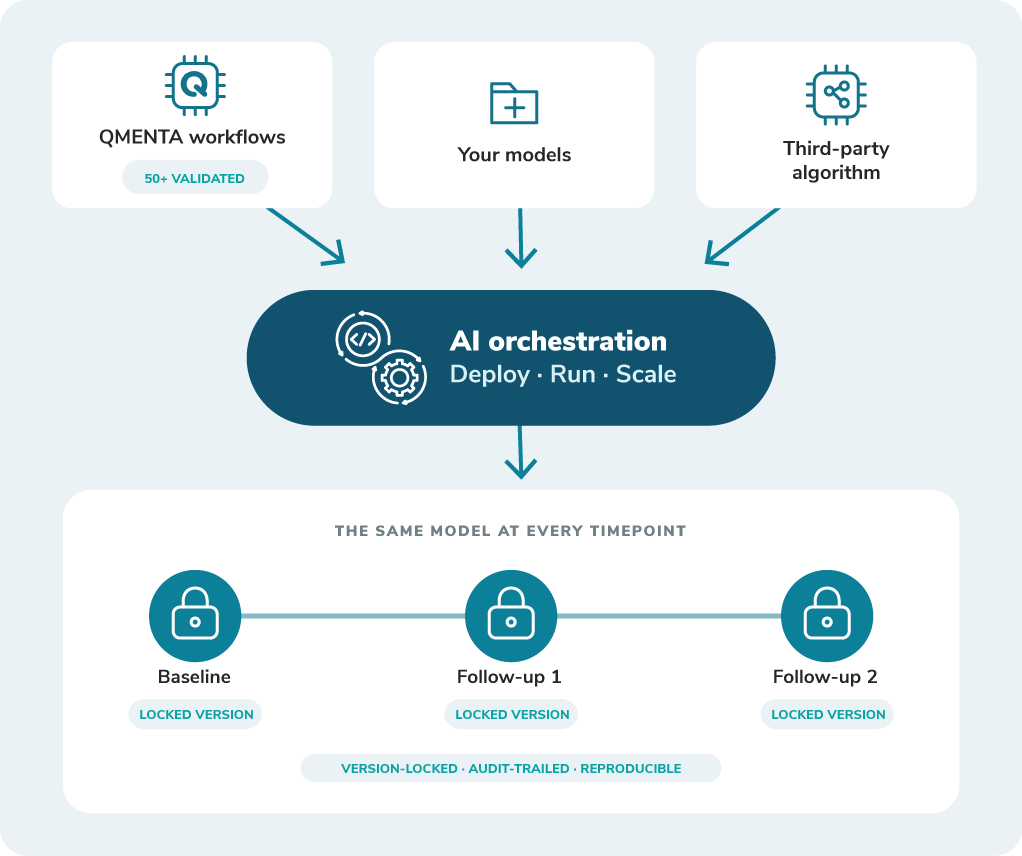
AI orchestration layer diagram
Central review and collaboration

All stakeholders on the same data, in real time.

Investigators, radiologists, data managers, and collaborating sites work from the same dataset through a zero-footprint browser viewer with fast load times. Role-based access, dedicated worklists, and automated audit logging replace fragmented file transfers and disconnected review. For Study and Pivotal users, this removes the manual coordination that slows multi-site programs.

+Zero-footprint browser viewer, no local installation

+Role-based access for sites, investigators, and core review teams

+Automated, time-stamped audit logging from day one
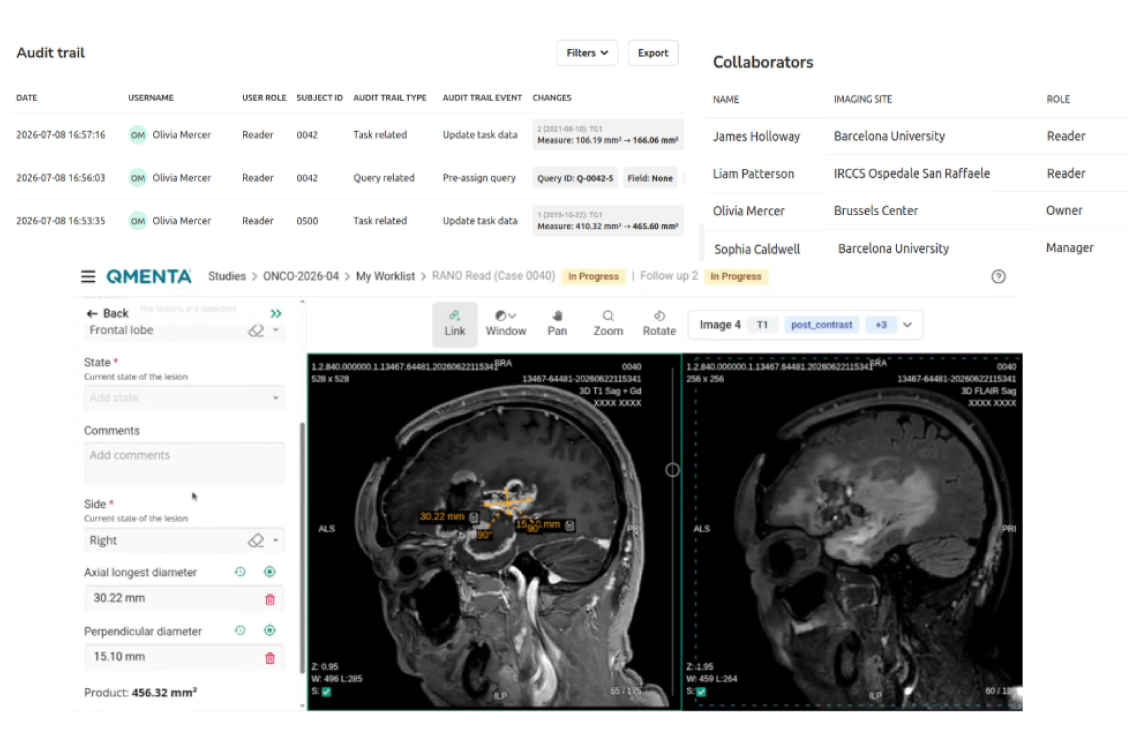
Browser viewer with role-based panel and audit log image<
Built for regulated environments

Compliance is a mechanism, not an adjective.

QMENTA was designed for regulated environments from the ground up, not retrofitted for them. Chain of custody, automated time-stamped logs, and data capture at the infrastructure level are what make an audit trail hold up, and they are in place from day one, whichever use case you run.

510(k)-cleared platform FDA 21 CFR Part 11 HIPAA GDPR ISO 13485 GxP

The 510(k) clearance (K202718) covers the QMENTA platform as a medical image management and processing system. It is not a clearance of individual AI workflows as diagnostic devices.

GCP, AWS, or Azure

Deployable on whichever cloud meets your security and procurement requirements.

Vendor-neutral DICOM

GE HealthCare, Siemens Healthineers, Philips, Canon, United Imaging, and any DICOM-compliant system.

Full chain of custody

From first scan to regulatory submission in one system, so the record is complete when a reviewer asks.

Fully independent

No pharmaceutical company investment in the platform, a governance requirement in regulated environments.

Trusted by

Cleveland Clinic
UCSF
NIH
Bayer
Icon
Athinoula
Ready to build on governed infrastructure?

Talk to an imaging scientist.

Tell us about your program. We will tell you which use case fits, what setup looks like, and what it costs.

Running an industry-sponsored neuro trial? Explore Trials   |   Quantifying TBI for litigation? Explore Legal