Artificial intelligence is transforming industries at a rapid pace, but in clinical research, especially neurology, adoption has been slower. The stakes are high: complex imaging data, regulatory expectations, and patient needs demand solutions that are rigorous and reliable.
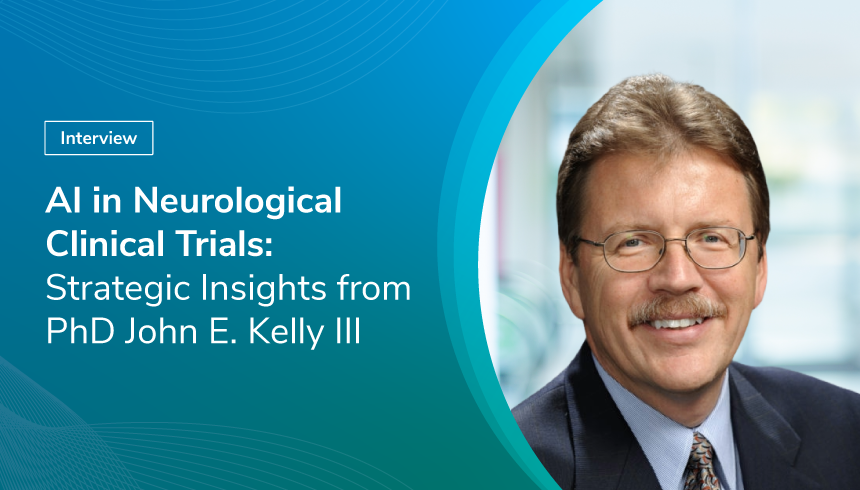
Few people are better positioned to speak on this challenge than Dr. John E. Kelly III. Widely recognized as the “father of IBM Watson”, Dr. Kelly has spent decades at the forefront of AI innovation. Today, he is one of the leading voices on how AI can responsibly support healthcare and clinical trials.
In this interview, Dr. Kelly shares his perspective on the opportunities, obstacles, and future of AI in neurological research and clinical trials, and the lessons that remain relevant for sponsors, researchers, and innovators alike.
Q1. How Is AI's Evolution Shaping Its Role in Clinical Research and Neurology?
Dr. Kelly: AI has gone from being an abstract concept to becoming a practical tool that touches everyday life. In clinical research — especially neurology — its potential is extraordinary. We can now process vast volumes of imaging and clinical data that were previously too complex to analyze. This capability allows us to identify patterns, design more effective trials, and ultimately generate insights that improve patient outcomes.
Q2. What's Holding AI Back in Clinical Trials — and How Do We Overcome It?
Dr. Kelly: Trust, data, and culture are the main barriers. Researchers and regulators need confidence that AI systems are scientifically valid and explainable. Data is often fragmented or non-standardized, which reduces reliability. And culturally, the introduction of AI requires shifts in established workflows, which can be uncomfortable. Overcoming these challenges will take rigorous validation, open standards, and collaboration between academia, industry, and regulators.
This theme of trust and adaptation leads naturally to the lessons learned from Watson, one of the earliest large-scale healthcare AI projects.
Q3. Lessons from IBM Watson: What AI in Healthcare Still Gets Wrong
Dr. Kelly: Watson demonstrated both the promise and the hurdles of AI in healthcare. The lessons remain clear: AI must integrate seamlessly into existing systems; usability is critical if clinicians and researchers are to adopt it; and transparency in how AI reaches conclusions is non-negotiable. These principles are timeless, and they remain essential as we push AI further into clinical research.
Q4. Why Data Quality and Standardization Are the Foundation of AI-Enabled Trials
Dr. Kelly: Data is the foundation of everything. Without quality and harmonization, AI cannot produce results that are reliable or reproducible. This is why global standards and harmonization across sites are essential. Collaboration is also key — no single organization can solve this alone. When institutions share data responsibly and agree on frameworks, AI has the potential to accelerate progress across the entire research ecosystem. It’s also why next-generation, cloud-based AI platforms like QMENTA are so critical to success — they provide the infrastructure to ensure data quality, standardization, and scalability across trials.
Q5. How QMENTA Addresses the Core Challenges of AI in Clinical Research
Dr. Kelly: What stands out about QMENTA is how it combines scientific depth with operational practicality. The platform enables researchers to manage complex imaging datasets securely, harmonize data across multiple sites, and apply advanced AI analytics at scale. That combination — compliance, quality, and accessibility — is exactly what the field needs to move AI from potential to practice. QMENTA is helping create the kind of trusted environment where AI can accelerate clinical development while maintaining scientific rigor.
Q6. The Next 10 Years: AI's Impact on Clinical Trials and Patient Outcomes
Dr. Kelly: I see AI transforming every phase of the clinical trial process. Patient selection will be more precise, endpoints will be more sensitive, and imaging will play a stronger role in linking biology to outcomes. The trials of the future will be faster, more efficient, and more informative. For patients, this means earlier access to therapies and a higher likelihood that those therapies succeed once they reach clinical practice.
Conclusion:
Dr. Kelly’s insights make one point clear: AI is not simply a tool — it is a catalyst for more rigorous, collaborative, and patient-centered research. The opportunity is here, but realizing it depends on trust, high-quality data, and cross-sector collaboration.
The future of clinical research lies at the intersection of visionary insight and practical implementation. By bringing these together, the industry can accelerate innovation — and deliver new therapies to patients with greater speed, clarity, and confidence.
Take the Next Step
The questions Dr. Kelly raises — around trust, data quality, and collaboration — are the very challenges shaping the future of clinical trials. At QMENTA, we work side by side with research teams to tackle these issues in practice. Our purpose is to empower the world’s leading innovators to accelerate the discovery of cures for brain diseases by removing the complexity of medical imaging data.
If you’d like to explore how we can empower your studies approach could support your own studies, Schedule a 30-minute technical demonstration .
Our team is ready to connect, understand your imaging challenges, and help you reach your research goals. We’ll show how our platform can adapt to your specific requirements.
Frequently Asked Questions
What are the main barriers to AI adoption in neurological clinical trials?
According to Dr. John E. Kelly III, the three primary barriers are trust, data quality, and organisational culture. Researchers and regulators need confidence that AI systems are scientifically valid and explainable. Imaging and clinical data are often fragmented or non-standardised across trial sites, which reduces AI reliability. Culturally, integrating AI requires changes to established workflows that can be uncomfortable for clinical teams. Overcoming these challenges requires rigorous validation of AI tools, adoption of open data standards, and sustained collaboration between academia, industry, and regulatory bodies.
What lessons from IBM Watson are still relevant for AI in clinical research?
Watson demonstrated both the promise and the practical hurdles of deploying AI in healthcare. Three lessons remain central: AI must integrate seamlessly into existing clinical and research systems rather than requiring teams to change their core workflows around it; usability is critical — if clinicians and researchers cannot easily adopt a tool, it will not be used regardless of its technical merit; and transparency in how AI reaches conclusions is non-negotiable, particularly in regulated settings where decisions must be auditable and explainable.
How does data quality affect the performance of AI in clinical trials?
Data quality is the foundation of everything AI produces in clinical research. Without harmonised, standardised data across trial sites, AI cannot produce results that are reliable or reproducible. Multi-site imaging studies are particularly vulnerable to data quality issues because different scanner vendors, acquisition protocols, and site-level variations introduce inconsistencies that degrade model performance. Cloud-based platforms that enforce standardisation at upload, automate quality control, and maintain compliant audit trails are therefore critical infrastructure for AI-enabled trials.
What role will AI play in clinical trials over the next ten years?
Dr. Kelly foresees AI transforming every phase of the clinical trial process. Patient selection will become more precise through AI-driven biomarker stratification. Endpoints will be more sensitive, with imaging playing a stronger role in linking biological changes to clinical outcomes. Trials of the future will be faster, more efficient, and more informative. For patients, this means earlier access to effective therapies and a higher probability that those therapies succeed in clinical practice.
Who is Dr. John E. Kelly III and why is his perspective on AI in clinical trials significant?
Dr. John E. Kelly III is widely credited as the architect of IBM Watson, one of the earliest and largest-scale deployments of AI in healthcare. He served as Senior Vice President of Cognitive Solutions and IBM Research, overseeing AI strategy across IBM's global operations. He is a member of QMENTA's Board of Advisors. His direct experience building large-scale healthcare AI systems — and witnessing both their successes and failures — gives him a uniquely informed perspective on what it takes for AI to move from potential to practice in regulated clinical environments.