Press Release
QMENTA appoints Rob Bancroft as New Chief Executive Officer.
January 22, 2020. QMENTA announce the appointment of Rob Bancroft as their new Cheif Executive Officer.
Learn how to integrate AI tools into medical imaging workflows using QMENTA’s cloud platform, including benefits, challenges, and a 3-step SDK deployment guide.
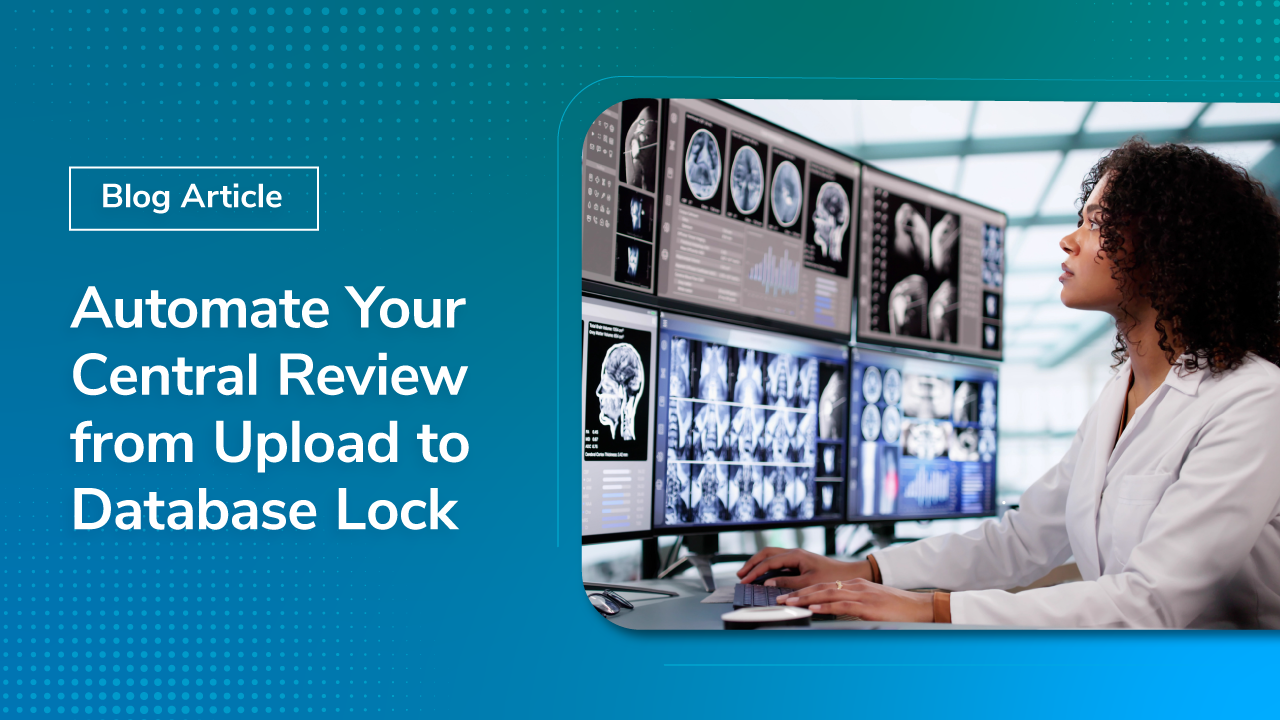
Clinical imaging teams are expected to move fast, yet most spend countless hours switching between viewers, eCRFs, and spreadsheets. Manual steps have become a silent drain on time and accuracy, introducing compliance risks and slowing down every stage of review.
Each new protocol makes the process even more complex. Configuring workflows for different studies often means long IT projects, rigid systems, and layers of unnecessary manual oversight.
These aren’t just inefficiencies; they’re risks to data quality, audit readiness, and trial timelines.
When imaging data, measurements, and reviews live in separate systems, errors are inevitable. File naming mistakes, mismatched measurements, or delayed adjudications can all impact data integrity. In regulated studies, this means additional monitoring, queries, and delays in database lock.
Automation and AI can help — but only if they work with your team, not against it.
Join our live webinar, New Approaches to Automating Your Central Review from Upload to Database Lock, to see how QMENTA’s AI-powered imaging platform brings all review activities, upload, QC, measurement, and adjudication together in one unified environment.
You’ll discover how imaging teams can:
By integrating AI-driven automation into everyday workflows, radiologists and imaging operations teams can focus on what matters most: consistent, high-quality image interpretation.

AI integration in medical imaging offers five primary advantages: reproducibility — AI algorithms produce consistent results regardless of fatigue or subjective state, unlike human reviewers; reduced human error — well-designed AI algorithms maintain a constant, predictable error profile; pattern recognition — AI can identify complex features in imaging data that exceed human visual detection; early-stage disease detection — AI can detect subtle patterns indicating disease before they are visible to a human reader; and time and cost efficiency — AI systems can process images in seconds compared to hours for manual analysis, with some tools like FastSurfer completing full brain segmentation in under one minute.
The main challenges are: data requirements — AI models require large, well-organised training datasets that are difficult and expensive to assemble, particularly given HIPAA restrictions on image sharing; AI hallucinations — AI models can produce incorrect results due to insufficient or biased training data, making validation essential before clinical or trial use; data security — medical imaging data is highly sensitive, requiring strict regulatory compliance for both local and cloud deployments; and workflow integration — while technically straightforward with the right infrastructure, integrating AI into existing systems requires planning and the right development environment.
QMENTA's Imaging Hub is a cloud-based platform for securely uploading, storing, and processing medical images, with access to unlimited storage and computing power for running AI tools. Integration of a new AI tool follows three steps: writing or adapting the main AI algorithm; building and pushing a Docker container with the appropriate environment; and adding the tool to the QMENTA Imaging Hub using developer access. The platform's SDK supports any programming language through containerised images, and tools can be distributed to the broader QMENTA research community through the tools catalogue, including through a revenue-sharing model.
An AI hallucination in medical imaging refers to a situation where the model produces results that appear plausible but are incorrect — for example, incorrectly segmenting a region as a lesion or misidentifying tissue type. This occurs due to insufficient training data, biased datasets, or incorrect model assumptions. Mitigation strategies include training on large, diverse, and well-annotated datasets; external validation on data from different sites and scanners; prospective clinical validation rather than solely retrospective testing; and human-in-the-loop review workflows where AI outputs are reviewed and refined by qualified experts before clinical or regulatory use.
January 22, 2020. QMENTA announce the appointment of Rob Bancroft as their new Cheif Executive Officer.
Boston, MA, 29/11/21 QMENTA announced today that the U.S. Food and Drug Administration (FDA) has granted 510(k) clearance for its QMENTA Platform for...
Boston, MA, March 29, 2023— QMENTA, Inc. announced today that John E. Kelly III, PhD has been appointed to the company's Board of Advisors. Dr. Kelly...