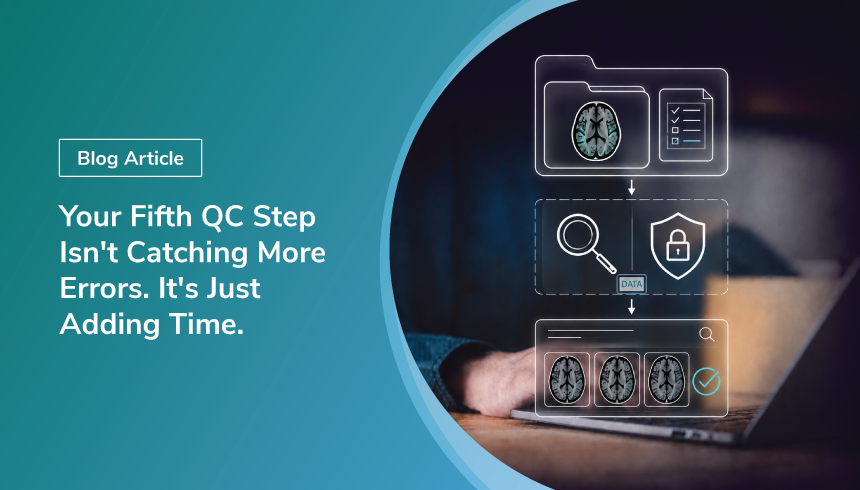
Quick answer: More quality-control steps do not automatically mean fewer imaging errors. Once checks duplicate each other, run after the rescan window closes, or lead to no clear action, they add delay without adding quality. A useful QC step should catch a distinct risk, act in time, and trigger a decision.
In a multi-site imaging trial, nobody sets out to add process for its own sake. A QC step almost always starts life as a fix for something real.
Before long the workflow has five separate chances to inspect the data, and problems are still surfacing too late.
That is how a sensible safeguard turns into a bloated process. You can justify every step on its own, yet the system as a whole gets slower and harder to run without getting any more reliable.
Quality control is not optional. But more of it does not always mean better quality. The question worth asking is not how many times you check the data. It is whether each check actually changes the outcome.
Does one more QC step actually make the data safer?
Sometimes. Not automatically.
A QC step earns its place when it controls a real risk that nothing else is already handling. If the site, the CRO, and the central review team all inspect the same acquisition parameters from the same information, those extra passes may feel reassuring. They may also just be the same work done three times over.
The FDA's guidance on clinical trial imaging endpoints centres on getting protocol-compliant imaging, holding quality steady within and across sites, and keeping a verifiable record of the imaging process. ICH E6(R3) points the same way: trial processes should be proportionate to risk, workable in practice, and free of complexity that earns nothing. Neither treats "more manual checks" as a synonym for "better quality."
Where does extra QC add cost instead of quality?
QC turns into drag when it repeats itself, runs in sequence, or sits too far from the moment of acquisition. The tells are usually visible in the workflow:
- Central reviewers find acquisition problems after corrective action is off the table, by which point the endpoint data is already gone.
- Site staff check information the CRO is about to check again.
- Imaging specialists manually verify parameters that could have been automatically read at upload.
- Deviations drift through email threads with no clear owner and no resolution deadline.
The biggest delay is rarely the check itself. It is the time the data spends waiting for someone to get to it.
That matters more in neuroimaging than in most places, because some errors have a short recovery window. A missing sequence, incomplete coverage, a motion artefact, a wrong acquisition parameter: several of these are fixable while the participant is still inside the scanner. Catch the same problem a few weeks later and you have an accurate QC record and no way to recover the endpoint. The check was technically correct and operationally useless.
For CRO operations teams there is a second cost. When review is manual, rising study volume looks like a staffing problem, so the instinct is to add people, even when the real issue is how the work is organised.
The four-point test
Put QC each step through four questions.
|
Test
|
Question
|
Evidence that it adds value
|
Warning sign
|
|
1. Distinct risk
|
Does it catch something another control does not?
|
It addresses a clearly defined, unique failure mode.
|
Different teams keep checking the same information.
|
|
2. Timely detection
|
Is the issue found while someone can still correct it?
|
The site can resolve or repeat the acquisition inside the allowed window.
|
The issue turns up during central review or reconciliation.
|
|
3. Clear action
|
Does failure trigger a defined decision?
|
The exception has an owner, a deadline, and a resolution path.
|
The result is logged or emailed, but nothing follows.
|
|
4. Measurable value
|
Can you prove the check is useful?
|
Findings, false positives, resolution time, and cost are all tracked.
|
The step stays because it feels reassuring, not because its value is known.
|
Score a point for every clear yes.
- Four points: keep it, and keep measuring it.
- Three points: keep it, but fix its timing, routing, or measurement.
- Two points: redesign it, and look hard at what it overlaps with.
- Zero or one point: investigate the overlap, and consider consolidation or automation through your change-control process.
None of this is a licence to pull a regulated control overnight. Anything defined by the protocol, the imaging charter, the quality system, or applicable regulation has to move through proper change control. The test is doing something narrower: it stops you assuming that every checkpoint you already have is still pulling its weight.
What does an efficient imaging QC process look like?
An efficient process swaps sequential approvals for one clear, closed feedback loop
Define what matters before the first scan. Expected sequences, acquisition parameters, naming conventions, image-quality thresholds, and escalation rules belong on paper before any site submits data. QC should enforce a standard everyone already agreed on, not ask each reviewer to reinterpret the protocol on the fly.
Run the repeatable checks at upload. Anything you can define consistently should run the moment imaging enters the trial environment: file completeness, expected sequences, acquisition parameters, metadata, de-identification, protocol adherence.
Send exceptions to people, not every submission. Human judgement is worth most when the answer is not obvious, such as borderline image quality, a tricky protocol decision, a clinically meaningful exception, or reader adjudication. Automate the repeatable checks and your specialists spend their time on the cases that actually need them.
Close the loop while the problem is still recoverable. Flagging a deviation is the start, not the finish. The workflow has to say who responds, what they need to do, and when it counts as resolved. A notification with no owner is not quality control. It is another unread message.
Measure outcomes, not activity. You want to know which controls catch real problems, which sites keep generating the same deviation, how long exceptions take to clear, and where false positives are creating busywork.
Better QC is earlier, not heavier
This is the shift QMENTA is built around. On the Platform, automated image and protocol QC starts the moment data is uploaded, so deviations can surface within minutes, while there is still time to act on them.
Before you add the next QC step, ask one thing: what unique error will this catch, and will the data still be recoverable when it does? If you cannot answer that cleanly, you may not be adding quality. You may just be adding another place for the data to wait.
Is your imaging QC preventing errors or documenting them too late? See how QMENTA supports real-time protocol QC, harmonisation, central review, and audit-ready imaging workflows for regulated neurological clinical trials.
No. More QC steps do not automatically mean fewer errors. Once checks duplicate one another, run after the rescan window closes, or do not trigger a clear action, they add delay without adding quality.
An imaging QC step adds value when it catches a distinct risk that no other control is already handling, acts while the data can still be corrected, and triggers a clear decision or escalation.
Delays often come from sequential reviews, duplicated checks across sites, CROs and central reviewers, unclear ownership, and imaging data waiting in queues for manual review.
Repeatable checks such as file completeness, expected sequences, acquisition parameters, metadata, de-identification, and protocol adherence can run when imaging enters the trial environment.
Ask four questions: Does the step catch something another control does not? Is the issue found while someone can still correct it? Does failure trigger a defined decision? Can you prove the check is useful? A step that scores poorly may need redesign, consolidation, or automation through the appropriate change-control process.
No. Any control defined by the protocol, imaging charter, quality system, or applicable regulation must move through the proper change-control process. The four-point test helps identify controls for investigation; it is not a licence to remove regulated controls overnight.